
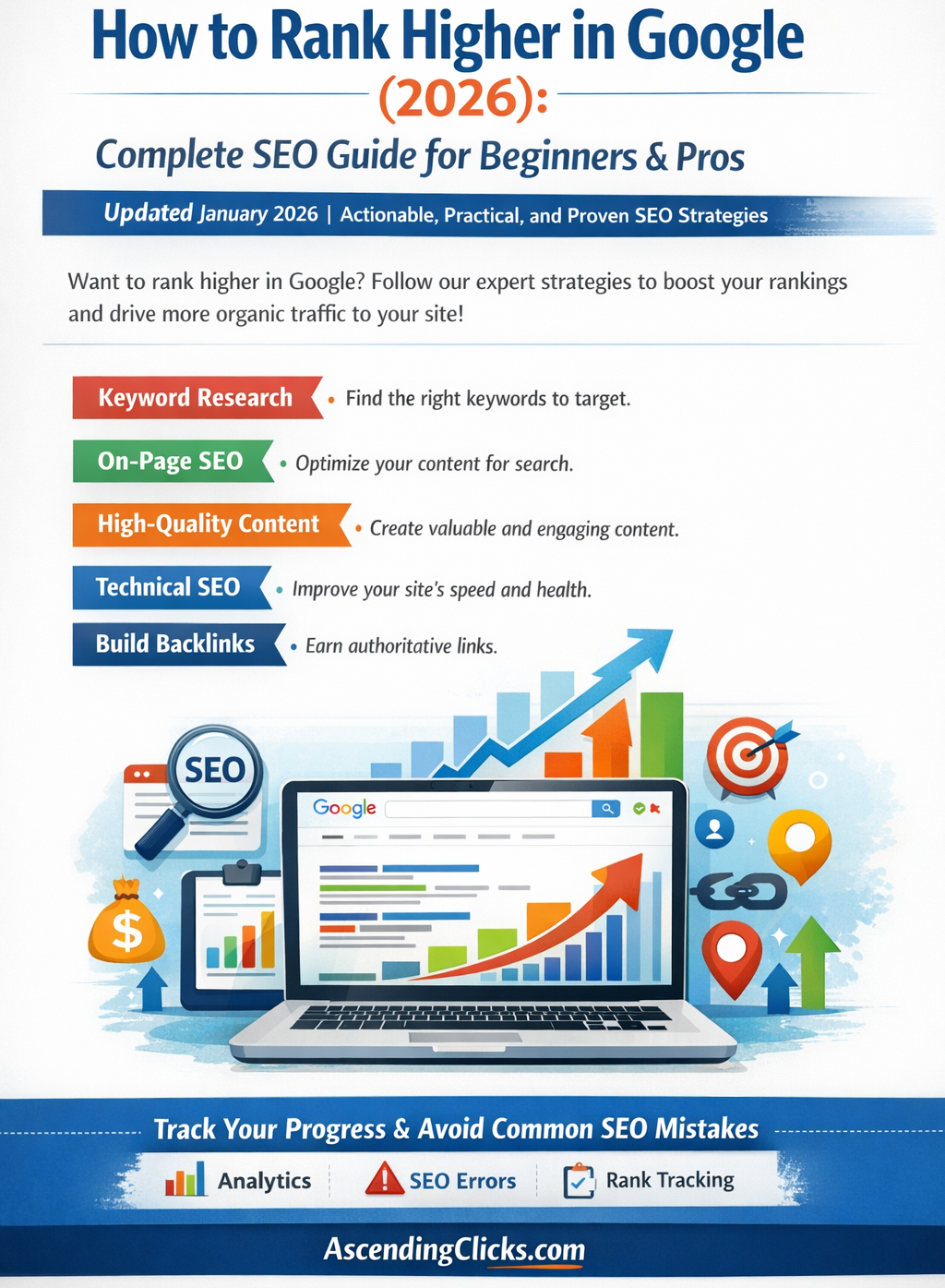
How to Rank Higher in Google (2026): Complete SEO Guide for Beginners & Pros
SEO Success in Action: Essential Strategies to Rank Higher in Google (2026 Guide)
Updated January 2026 | Actionable, Practical and Proven SEO Strategies
Want to rank higher in Google and get more organic traffic? You’re in the right place. Search Engine Optimization (SEO) is the foundation of online visibility and mastering it can help your website reach new audiences, generate leads and grow your brand. In this ultimate 2026 guide, we break down how Google ranks pages, the latest ranking factors, and step-by-step actions you can take today to climb the search results.
Table of Contents
- How Google Ranks Pages (Quick Overview)
- Keyword Research: The Foundation of SEO
- On-Page SEO: Optimize for Users & Search Engines
- High-Quality Content That Google Loves
- Technical SEO: Improve Your Site’s Health
- Backlinks: Building Authority, the Right Way
- User Experience & Engagement Signals
- Local SEO (if you serve a local audience)
- Tracking SEO Performance
- Common SEO Mistakes to Avoid
- Final Thoughts
1. How Google Ranks Pages (Quick Overview)
Google’s algorithm uses hundreds of factors to decide which pages appear first. At a high level, Google evaluates:
Relevance: Does your page answer the searcher’s query?
Authority: Does your site have trust and credibility?
User Experience: Is your site fast, secure, and easy to use?
Google’s core algorithm updates continue to reward helpful, original, and user-focused content according to https://blog.google/products/search/
2. Keyword Research: The Foundation of SEO
Keyword research helps you understand what people search for and how to align your content to those terms.
Steps to do keyword research:
✔ Find primary topic keywords (e.g., “how to rank higher in Google”)
✔ Identify long-tail keywords (e.g., “SEO tips for beginners 2026”)
✔ Check search intent: informational, transactional, navigational
✔ Analyze keyword difficulty and opportunity
Tools you can use:
- Google Keyword Planner
- Ubersuggest
- Ahrefs / SEMrush
Tip: Target keywords with a mix of search volume and achievable competition.
3. On-Page SEO: Optimize for Users & Search Engines
On-page SEO refers to elements you control within your content and HTML.
Key on-page elements:
- Title Tag: Include your focus keyword (60 characters)
- Meta Description: Brief, persuasive summary (150–160 characters)
- Headers (H1, H2, H3): Organize information and include keywords
- URL Slug: Short + keyword-rich
- Image Alt Text: Describe images using relevant keywords
- Internal Links: Link to related pages on your site
Example
Title: How to Rank Higher in Google (2026 SEO Guide)
Meta: Learn proven SEO strategies to rank higher in Google search and grow organic traffic.
4. High-Quality Content That Google Loves
Content is still king, but quality matters more than ever.
Your content must be:
🟢 Useful
🟢 Accurate and up-to-date
🟢 Easier to read than competitors
Content best practices:
- Answer the user’s question clearly and completely
- Use visuals like charts, screenshots, and diagrams
- Add examples and action steps
- Update old posts regularly
Google values comprehensive, original content that satisfies user intent.
5. Technical SEO: Improve Your Site’s Health
Technical SEO ensures your site is accessible and fast for both users and search bots.
Important technical factors:
✅ Mobile-first design: Google uses mobile versions first for ranking.
✅ Site speed: Faster pages rank better. Compress images, use caching.
✅ Secure HTTPS: Always use SSL certificates.
✅ Sitemap & Robots.txt
Help search engines crawl and index your site.
You can test technical issues with:
- Google Search Console
- PageSpeed Insights
6. Backlinks: Building Authority the Right Way
Backlinks (links from other sites to yours) are one of Google’s strongest ranking signals.
How to earn backlinks:
⭐ Create link-worthy content (guides, research, tools)
⭐ Guest post on relevant blogs
⭐ Reach out to influencers and websites
⭐ Get listed in industry directories
⚠ Avoid spammy link schemes; they can get your site penalized.
7. User Experience & Engagement Signals
Google looks at user behavior to understand if your page is satisfying visitors.
Key engagement signals:
- Click-through rate (CTR)
- Time on page
- Bounce rate
- Pages per session
How to improve UX:
💡 Make content scannable with subheaders
💡 Add relevant visuals
💡 Improve navigation
💡 Ensure fast loading
Good UX keeps people on your site longer and Google notices.
8. Local SEO (If You’re Targeting Local Customers)
If your business serves local customers, local SEO helps you rank in local search and Google Maps.
Local SEO basics:
🟡 Claim and optimize Google Business Profile
🟡 Add local keywords (city + service)
🟡 Earn local reviews
🟡 Consistent NAP (Name, Address, Phone) across directories
Example keyword: SEO services in Nairobi
9. Tracking SEO Performance
Use these key tools to monitor your SEO progress:
📍 Google Analytics: traffic, behavior, conversions
📍 Google Search Console: search performance, coverage
📍 SEO tools: keyword rank tracking
Track metrics like:
📌 Organic traffic
📌 Keyword rankings
📌 Bounce rate
📌 Backlinks
Regular tracking helps you refine your strategy.
10. Common SEO Mistakes to Avoid
❌ Keyword stuffing
❌ Duplicate content
❌ Ignoring mobile users
❌ Slow loading pages
❌ Low-quality backlinks
Avoiding these keeps your SEO clean and effective.
Conclusion
Ranking higher in Google isn’t magic; it’s strategy + consistency.
Focus on:
📌 Keywords that match search intent
📌 User-friendly, helpful content
📌 Technical health and site speed
📌 Building authority with backlinks
📌 Tracking and updating your strategy
If you apply these SEO practices consistently, your site can climb the rankings and stay there.